
 10 min read


The Illusion of Progress
There was a time when rankings and traffic defined digital marketing — master those two metrics, and you win. Or not.
You may recognize the unsettling experience of watching your traffic rise while holding a #1 ranking on Google, only to find that you're still losing out on deals.
Why? In a word: visibility. In three words: Visibility is relative.
The goal of driving traffic and rankings up is to increase visibility, but if you're not keeping a close eye on that visibility prize, then the cost is counted in lost revenue.
This post examines the shift in digital marketing, from prioritizing absolute metrics above all else to an increasing focus on competitive positioning, or share of visibility.
Absolute vs Relative Visibility
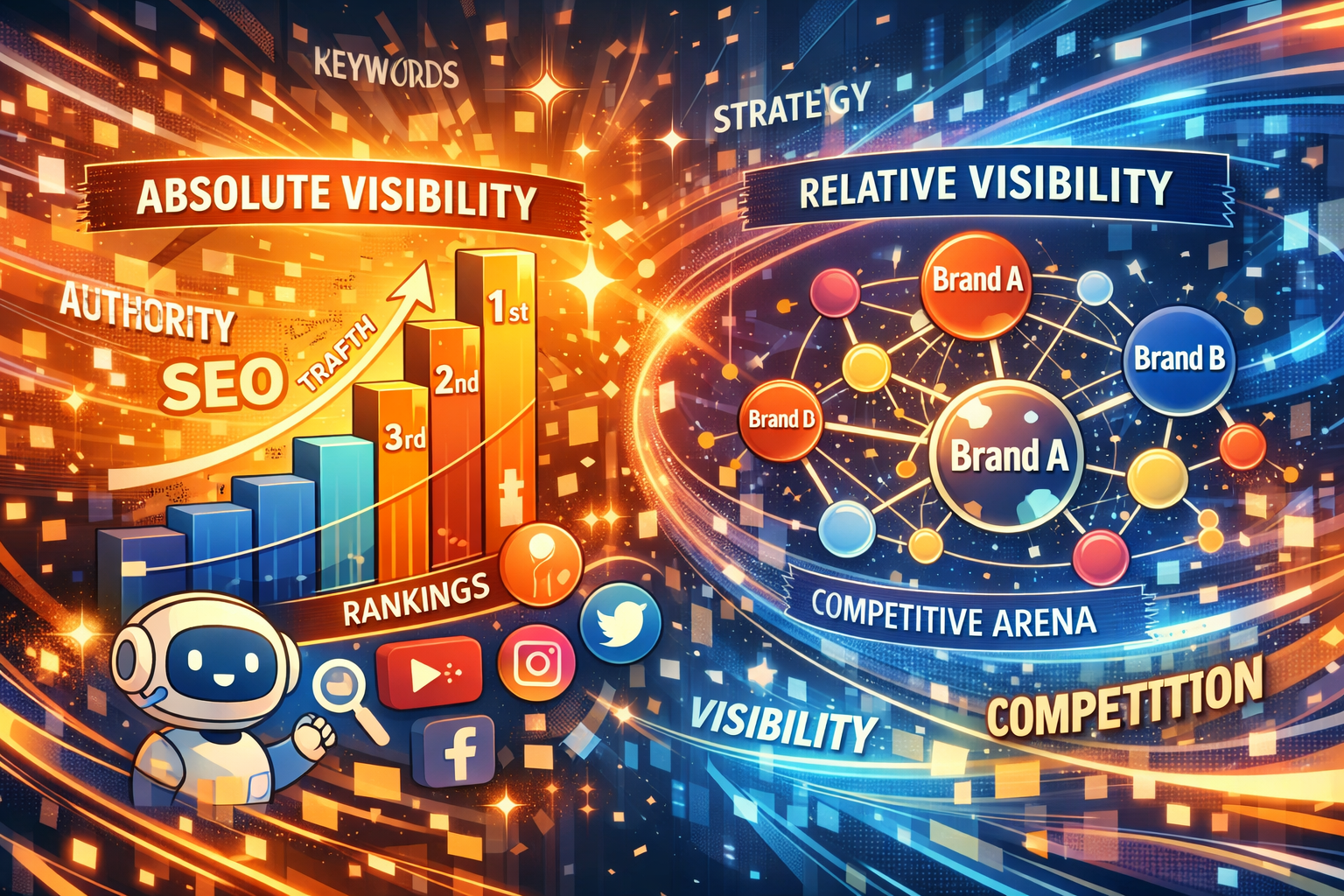
There are two basic measures of visibility: absolute and relative.
Absolute visibility is your metrics in isolation. It's that #1 ranking or that stellar traffic growth.
Relative visibility is your position in relation to your competitors. It's a more nuanced measure that accounts for your overall presence and how that stacks up against other players in the same space.
Absolute visibility was once the primary metric when it was reasonable to assume the consumer progressed linearly from search to link click to purchasing decision. But that's not how buying decisions get made in today's world.
It's currently estimated that more than 60% of browser-based Google searches don't generate a click — users search a keyword and get the information they need from an AI summary at the top of the page. How do we meaningfully measure online visibility in an increasingly zero-click world, where a #1 keyword ranking can leave the top unclicked link below the AI overview? That's why it's important to measure relative visibility — your share of the overall conversation around the products or keywords that matter to you, which means looking beyond search results alone.
The Three Competitive Arenas
The broader concept of relative visibility requires recognizing that the competitive arena has expanded. In fact, there are at least three:
- Search results: The traditional measure of online visibility is still relevant; it's just that the share of search is no longer the only race you're trying to win.
- Earned authority: The amount of news and PR coverage you receive, your mentions on social media and in general discussion online, backlinks to relevant content on your site — all elements of the broader conversation taking place beyond search.
- AI-generated answers: When AI agents scour the web for answers, are you the answer they are looking for?
The new paradigm requires the same dedication to dominating these three arenas as was once required for winning at SEO.
Why Competitors Win Without You Noticing
Companies that don't recognize how digital marketing has evolved beyond a sole focus on search results often feel a disconnect between their online growth and the broader movement within their industry or product category.
You may have impressive traffic growth stemming from a #1 ranking on a particular keyword, but your competitors may have already moved the conversation beyond those keywords. Instead of winning the rankings battle, they now own key pages that consumers visit for information. That ubiquitous presence leads to more citations, which in turn increases how often they appear in comparisons and AI overviews.
You may be growing, but you're fundamentally moving slower — and possibly farther away from your target audience.
This is how your competitors win without you noticing: You're focused on a search keyword when you should focus on overall visibility relative to your competition. You haven't noticed that you're losing ground because you haven't noticed that the competition has shifted to new arenas.

The Concept of “Share of Visibility”
To be clear, share of visibility is a different and distinct concept from share of voice. The traditional share of voice metric addresses paid media, measuring your company's share of total media spending on a particular product or category. Share of visibility is a broader measure of your company's overall presence in the conversation around a particular product or category.
This can include your rankings for certain keywords, mentions in relevant discussions on key service pages, and your company's inclusion in answers provided by AI summaries. These are the factors that actually influence buyers in a world where around 50% of Google searches generate an AI summary (a percentage that will only rise over time), and close to 50% of consumers say they use AI when making purchasing decisions.
Share of visibility is about tracking your real presence in every forum that matters to your consumers. This means considering everything from relevant TikTok trends to mentions by influencers on LinkedIn to how your company shows up on YouTube channels important to your core audience.
Capturing a meaningful share of visibility metrics will bring you closer to understanding where your brand sits in the discussions that actually influence buyers.
Where to Analyze Competitors
Perhaps the biggest mindset shift in analyzing relative visibility is a move from the strategic to the tactical. You need to analyze your competitors' presence and performance in the places that are important to consumers — that means getting down to the page level, not trying to dominate at the domain level.
Focus your attention on the places where relevant conversations happen: service pages, category pages, and comparison content. This is the content that defines the substance of the conversation around your product category. If you're not winning the visibility battle in these places, you have some catching up to do.
The Authority Gap
Authority is a critical factor in driving brand trust. Brand trust is the respect and loyalty that consumers have for your brand, often described as the degree to which they believe your brand has followed through on its promises. A high degree of brand trust correlates with a willingness to pay more for a product or service and is a strong factor in deciding between brands.
A high degree of visibility — good page rankings and solid traffic numbers — without authority might mean your brand is little more than comparison fodder. You might be appearing in conversations and discussions as the perennial "not that one" in a "pick this but not that" recommendation. Brand visibility without authority does not deliver brand trust.
Closing an authority gap with a competitor takes time, but can be achieved with a dedicated, methodical approach.
Start by defining those areas where you're competitive and those areas where you're invisible. This helps you prioritize your effort, though perhaps not in the ways you might expect. Closing the authority gap requires an open mind regarding the strategic moves that matter to the goals you're trying to achieve.
Strategic Moves That Actually Matter
Once you've identified the areas where you're competitive and those where you're not visible, you can allocate resources effectively.
It's a good idea to start with the most achievable goals. Double down on the areas where you're close to your competitors. And by the same logic, don't waste resources on unwinnable battles — if you're lagging far behind in one area, ignore it.
For example, say you identify three core channels for connecting with your market — Reddit, LinkedIn, and Google. You're competitive on Google and Reddit, but you lack presence on LinkedIn. The approach you should focus on will close the gap with Reddit and Google, while ignoring LinkedIn.
How do you close the gap? Build authority systematically. In the same way that you analyzed which channels were important, analyze which subject areas hold the most value and see where you're most competitive. If you have a strong presence on how-to videos on YouTube, consolidate that until you are the dominant brand in that area. This will help you build recognition and authority in other channels and areas, and it builds on the existing strengths of your brand.
As you channel resources into areas of strength, you'll gradually build recognition and authority. This will either boost your presence in areas of weakness, converting them into strengths you can develop, or it will not affect those areas, suggesting they are unlikely to reward further effort and focus anyway.
What Winning Looks Like Over Time
Winning share of visibility is about winning a war on several fronts. The goal is to build an authentic, organic advantage over your competition, using a methodical, strategic approach.
Over time, you want to develop a gradual dominance of key pages, with your knowledge and expertise increasingly acknowledged as the authority on critical subjects.
You're also looking to build increased mention frequency across the channels you've identified as important. Increasing mention frequency should generate something of a snowball effect across other channels. For example, those LinkedIn influencers you've ignored may organically start to mention you because you're impossible to ignore on Reddit and YouTube.
You still want to build or maintain a strong presence in search outputs, but this now includes AI summaries as well as the traditional search rankings. Appearing as a cited source or quoted expertise in AI summaries is an important element of the overall strategy — not least because it indicates that when an AI agent goes looking for what is important, it's finding your brand and your content.
Common Misreads
Just as it is important to understand what winning looks like, it's also important to focus on winning in the right places.
As previously mentioned, traffic growth in isolation isn't a reason to celebrate anymore. You need to ensure that the growth reflects the achievement of your strategic goals.
For example, if you focus on the wrong competitors, you may be misreading your growth entirely. You might be massively outperforming competitors who aren't relevant to your category, or who have conceded areas to you because they don't regard them as important. If you're getting more click-throughs from YouTube than any of your competitors, it might be because your competition has determined there's no value in winning YouTube.
Context is important. Be sure that you're competing in the right areas and measuring yourself against the right competition. Don't get distracted by vanity keywords or winning in places no one else is contesting.
Win the Visibility War, not Just the Ranking Battle
Ultimately, visibility is not about improvement. Rather, it's about outperforming alternatives in decision-making.
That said, improvement for improvement's sake is not the goal. Getting this month's traffic numbers to go higher than last month's or raising your search ranking on a particular keyword — these are increasingly empty metrics when there are ever-larger segments of your audience bypassing search completely, or merely using Google to generate an AI summary.
In what is becoming a zero-click search environment, the goal is to win share of visibility, not outspend competitors for share of voice or win the SEO wars and leave it at that.
Instead, marketers must be mindful that traditional search and traffic metrics are only part of the story. It's now essential to measure your presence across other channels in terms of content and conversations happening around subjects relevant to your brand.
Visibility in search is still an important element of marketing, but it's just one element. It has become vital to build brand trust with your audience — and that means increasing your overall visibility. It means being the source of the most reliable answers to common questions, being the most frequently cited or mentioned authority on a subject, and being the source most commonly recommended in AI summaries.
Online purchasing is increasingly about finding reliable, trustworthy information and recommendations, not simply searching for a keyword and clicking the top link. When you focus on improving your visibility, you build authentic trust and authority with your audience — and that is increasingly what drives purchasing decisions in the 21st century.

 11 min read