
 18 min read


When a company hires a B2B PR agency, what is the agency actually supposed to do?
The obvious answer is "get media coverage." That's certainly part of it. But if that's all you're getting, you're probably not getting much of a PR program.
I've run Idea Grove for more than 20 years, and the biggest change I've seen isn't that PR has abandoned media relations. It's that the value of good media relations now extends far beyond the audience that sees a story when it's published.
A story in an industry publication can introduce your company to prospective customers. It can give your sales team third-party validation to share with prospects. It can create a backlink that improves search authority. It can show up when someone Googles your company months or years later. Increasingly, it can also become part of the body of information AI platforms use when answering questions about your company or industry.
That has changed how we think about the job.
A modern B2B PR agency still pitches reporters. But the larger objective is to build the authority and visibility that make a company easier to find, understand and trust.
Here's what that actually looks like.
It Starts With Understanding Your Business
This is the least glamorous part of PR and one of the most important.
Before an agency can tell your story to anyone else, it needs to understand it.
For a B2B company, that can take some work. We've represented companies in data center infrastructure, enterprise software, telecom, contact centers, manufacturing and other industries where the products and buying processes aren't immediately obvious to an outsider.
The PR team needs to understand what you sell, who buys it, why they buy it, who you compete against and what is changing in your market. It needs to know which executives understand which subjects and which customers or partners might be willing to participate in stories.
More importantly, it needs to figure out what about your company is actually interesting to people outside your company.
Those aren't always the things you expect.
Companies naturally focus on themselves. They care about the new product, the new executive, the new office, the new partnership.
Journalists focus on their readers.
The agency's job is to find the intersection.
That's why one of the first things I look for in a PR agency isn't its media list. It's curiosity. Does the team ask good questions? Do they understand the business? Do they challenge you when something doesn't make sense?
You can't consistently find good stories about a company you don't understand.
A Good PR Agency Doesn't Wait for You to Have News
This is probably the biggest misconception I encounter about PR.
A lot of companies think the process works like this:
Something happens at the company. You tell the PR agency. The PR agency writes a press release. The PR agency pitches reporters.
If that's the entire program, you're going to have a lot of quiet months.
Most B2B companies simply don't generate enough genuine news to sustain media visibility all year. Even large companies don't have a major product launch, acquisition, funding round or executive appointment every few weeks.
So a good agency has to create opportunities rather than simply process announcements.
Maybe there's a breaking industry story your CEO can comment on.
Maybe your CTO has been seeing a technology problem that reporters haven't paid much attention to yet.
Maybe there's an interesting pattern in your customer data.
Maybe your company can conduct a survey that produces new information about your market.
Maybe an executive has a contrarian point of view that would make a strong contributed article or podcast discussion.
Maybe a trend that seems obvious to people inside your industry is completely unknown to the business press.
This is where much of the real work happens.
PR agencies don't control the news. They do control how hard they work to find legitimate ways for their clients to become part of it.
At Idea Grove, We Think About PR in Three Pillars
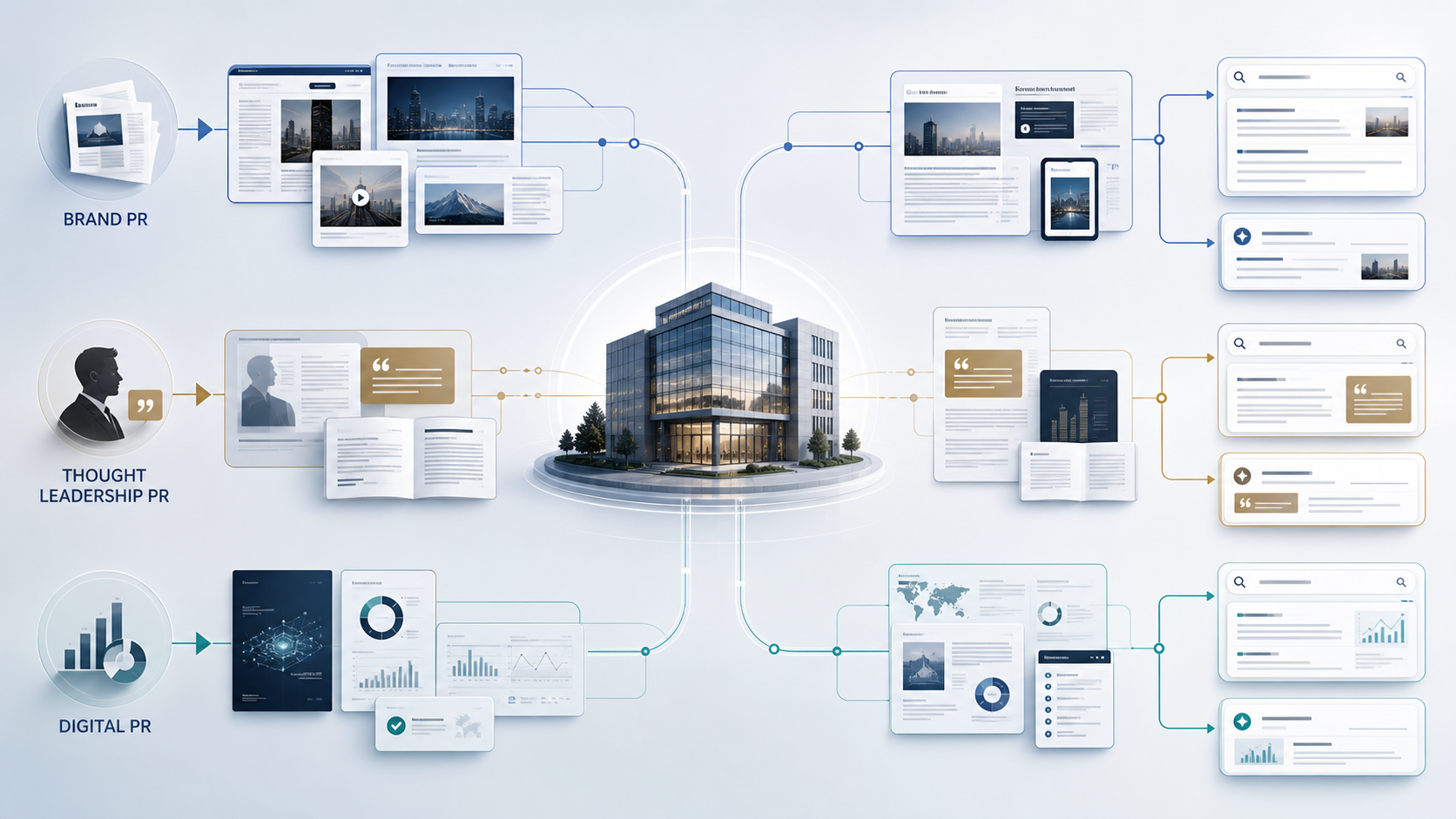
Over time, we've organized our PR work at Idea Grove into three pillars: Brand PR, Thought Leadership PR and Digital PR.
There is plenty of overlap among them, but each starts with a different question.
Brand PR asks: What's happening at the company?
Thought Leadership PR asks: What do the people at the company know?
Digital PR asks: What can the company create that other people will want to cite and link to?
A comprehensive PR program should be able to draw from all three.
Brand PR Builds the Company's Reputation
Brand PR is the closest to traditional corporate public relations.
It includes product launches, funding announcements, partnerships, customer wins, acquisitions, executive appointments, company milestones and other developments involving the business itself.
But sending a press release isn't Brand PR.
The agency still has to determine whether there's a story.
Suppose a software company launches a new feature. The company's product team may have spent a year developing it. Internally, it's a huge deal.
A reporter probably doesn't care.
But maybe that feature exists because customers are confronting a new problem across the industry. Now there's potentially a story.
The distinction is important.
A weak PR program tells journalists what the company wants to announce.
A strong PR program figures out why the outside world might care.
Sometimes the answer is that it won't. Part of the agency's job is being willing to say that.
Thought Leadership PR Builds the Reputation of Your People
Some of the best PR opportunities have very little to do with company news.
They come from expertise.
B2B companies are full of people who know things most people don't. A CEO may have spent 25 years in an industry. A CTO may understand an emerging technology better than almost anyone. An operations executive may be seeing changes in customer behavior long before those changes show up in industry reports.
Thought Leadership PR turns that expertise into visibility.
But there's an important distinction between having expertise and producing actual thought leadership. We've written before about why so much thought leadership is broken: publishing more executive content doesn't accomplish much if the executive isn't saying anything distinctive enough to be remembered.
Thought Leadership PR can include interviews with journalists, expert commentary, contributed articles, podcasts, broadcast appearances and other opportunities to put knowledgeable people into relevant conversations.
The key word is relevant.
Thought leadership isn't an executive writing generic LinkedIn posts about the importance of leadership.
The best thought leadership teaches people something.
It gives reporters a source who can explain what's happening. It gives buyers a reason to believe the company understands their problems. And over time, it can create a useful association between a person, a company and an area of expertise.
That's when the program really starts working.
Instead of the PR agency constantly asking journalists to talk to your executive, journalists begin coming back because they've learned that your executive is a useful source.
That doesn't happen overnight. But it's one of the most valuable things a B2B PR program can build.
Digital PR Creates Things Worth Citing
Digital PR has become the third major piece of the puzzle for us.
Traditional media relations is often about finding a story that already exists inside the company.
Digital PR can work differently. You create an asset specifically because it will be useful or interesting to people outside the company.
Original research is probably the clearest example.
We've developed nearly 100 survey campaigns for clients, covering everything from technology and healthcare to consumer behavior and workplace trends. The reason we keep coming back to surveys is that they give journalists something every PR person wants and can't manufacture with clever writing: genuinely new information.
A company can survey customers, consumers or industry professionals about a topic relevant to its market and uncover information that didn't previously exist. There's a whole process behind using PR surveys to generate media coverage and high-authority backlinks, from choosing the right topic to designing questions that will actually produce news.
Now you have something journalists can report.
You might have 20 or 30 interesting findings from a single survey. Some may appeal to national business publications. Others may work for industry trades. The research can become a report, a press release, media pitches, articles, sales content and social posts.
But the most important difference is that other websites now have a reason to cite you.
That's important because media coverage doesn't only generate awareness anymore.
A link from an authoritative publication can strengthen your search presence. A citation of your research can establish your company as a source on a topic. Those references can continue showing up in search results long after the campaign ends.
And now there is AI.
The public web is increasingly being read not just by people and search engines, but by AI systems trying to determine which companies and sources are authoritative on particular subjects.
That gives Digital PR a role that didn't exist when I started Idea Grove in 2005.
What Does a PR Agency Do Every Month?
The answer depends on the client, which is why I'm skeptical of PR programs built around rigid monthly deliverable counts.
One month may include a major product announcement. The next may have no company news at all but produce three strong thought leadership opportunities. Another may revolve around launching an original research campaign.
The mix changes.
But the work shouldn't stop.
A typical month might involve interviewing executives, monitoring industry news, developing story ideas, researching reporters, pitching commentary, writing a contributed article, preparing an executive for an interview, pursuing podcasts, developing an announcement, working on original research and following up on previous outreach.
There's also a lot of work clients don't necessarily see.
A pitch may go through several versions before it's sent. A PR professional may research dozens of reporters to identify the handful who actually cover the subject. A journalist may express interest and then disappear. Another may need three follow-ups before scheduling an interview.
Good media relations involves persistence without becoming a nuisance.
That's a skill.
The best PR teams also spend a lot of time simply paying attention. They read the publications they're pitching. They follow reporters. They watch what competitors are doing. They notice when an issue begins attracting attention and figure out whether the client has something useful to contribute.
That's difficult to capture in a list of deliverables, but it's where many of the best opportunities come from.
The Agency Should Tell You When an Idea Isn't Good Enough
This deserves its own section because I think it's one of the clearest ways to distinguish a strong agency relationship from a weak one.
Your PR agency should disagree with you sometimes.
Companies hire agencies partly because they want outside judgment. Yet agency teams can become so focused on keeping clients happy that they stop providing it.
The client says, "We should issue a press release about this."
The agency says, "Great idea."
The client says, "Our CEO should write an article about this."
The agency says, "Absolutely."
That's not much of a service.
If an announcement isn't newsworthy, I'd rather have the agency tell me before we spend hours writing and pitching it.
If a thought leadership idea sounds like something 500 other executives have already said, let's find a better angle.
If a survey question is obviously designed to produce a statistic flattering the company, a good journalist is going to see through it.
PR requires judgment because you're trying to earn the attention of people who have no obligation to give it to you.
Your agency should be protecting that standard.
Media Relations Is Still at the Center of the Job
With all the discussion today about Digital PR, SEO and AI visibility, it's possible to overcorrect and make traditional media relations sound almost old-fashioned.
I don't think it is.
Earned media remains at the center of what a good PR agency does.
There is still enormous value in having an independent journalist decide that your company, your research or your executive belongs in a story.
It reaches an audience you didn't have to build yourself.
It creates third-party validation you can't manufacture on your own website.
And it leaves behind a public record that can continue influencing how people perceive your company long after the article's initial readership has moved on.
What has changed is the number of ways that public record can create value.
PR Now Has a Second Audience: Machines
When we talk to clients about PR today, we're increasingly thinking about two audiences.
The first is the obvious one: people.
Journalists. Customers. Prospects. Investors. Employees. Partners.
The second is machines.
Search engines have been reading the web for decades. Generative AI has made that relationship much more visible because people can now ask ChatGPT, Gemini or Perplexity direct questions about companies and receive direct answers.
Which companies are the leaders in this category?
What are the best alternatives to this vendor?
Who are the experts on this subject?
Is this company reputable?
Those systems need information to answer.
Your own website is part of that information environment. But so are articles about your company, interviews with your executives, citations of your research, backlinks, reviews and other third-party references.
We've seen this connection in our own client work.
In one recent program, a client's overall AI visibility increased from 47.5% to 52.9% over two months, while its visibility in ChatGPT increased from 44.6% to 57.9%. We're careful not to claim that an individual PR placement directly caused an individual AI response to change. AI visibility doesn't work that neatly.
But the broader pattern we've seen is increasingly hard to ignore: companies with strong, relevant third-party authority tend to have a better foundation for AI visibility.
We've seen that pattern repeatedly in our AI visibility audits, which is one reason I've described AI as a new gatekeeper to B2B consideration sets. A company can lose a prospective customer before that person ever reaches its website if it never makes the initial list of vendors an AI platform recommends.
That's why we now measure PR's value more broadly than media impressions alone.
PR, SEO and AI Optimization Are Starting to Converge
For most of my career, companies treated PR and SEO as separate disciplines.
The PR agency pursued media coverage.
The SEO agency pursued rankings and backlinks.
The content team wrote blog posts.
Now someone is probably responsible for AI visibility too.
The buyer doesn't care about those organizational boundaries.
A prospect might hear your company's name in a podcast, Google you two weeks later, see a trade publication story about you, visit your website and eventually ask ChatGPT to compare you with two competitors.
From the prospect's perspective, that's one research process.
From the company's perspective, it may touch four different agencies or departments.
That's a problem.
At Idea Grove, we've been moving toward what we call a Total Visibility System for exactly this reason. It aligns earned media, content, SEO and AI optimization so the work in one area strengthens the others. As I've written in more detail, the problem with many B2B visibility programs isn't that the individual pieces aren't working; it's that PR, SEO, content and AI visibility are working independently instead of reinforcing one another.
The point isn't that every PR agency needs to become an SEO agency.
It's that PR teams should understand what happens to their work after the story runs.
If you earn a great placement with a backlink, where does the link point?
Does it support a page that matters commercially?
Does your content reinforce the same areas of expertise you're establishing through PR?
Are you measuring whether the topics you're building authority around are also the topics where you want to appear in Google and AI answers?
That's where the architecture matters. In our Total Visibility approach, we identify the pages and topics most closely connected to pipeline and then concentrate PR, content, SEO and AI efforts around building authority there. I've explained how that system works in practice here.
Those questions didn't appear on many PR plans 10 years ago.
They should now.
PR Builds Trust Signals
The common thread through all of this is trust.
I wrote Trust Signals in 2022 around a simple premise: Companies can make almost any claim they want about themselves, but buyers look for evidence before believing those claims.
Your website says you're an industry leader.
That's a claim.
A respected publication repeatedly quoting your executives is evidence.
Your website says customers love you.
That's a claim.
Hundreds of verified customer reviews are evidence.
You say your company has expertise in an emerging technology.
That's a claim.
Journalists interviewing your people, industry sites linking to your research and other experts citing your work are evidence.
Those are trust signals. I've been writing about this idea since well before generative AI arrived; at its simplest, a trust signal is an evidence point that helps someone decide whether to believe or trust a brand.
PR is particularly good at creating them because the most valuable outcomes occur somewhere other than your own website.
That's also why PR has become so relevant to AI visibility. The same public evidence that helps a skeptical buyer decide whether you're credible gives machines more information about who you are and what you're known for.
Idea Grove's Total Visibility System grew directly from that Trust Signals® Framework rather than from the idea that PR, SEO and AI optimization should simply be bundled together as services.
What Should Your PR Agency Report?
PR reporting has traditionally revolved around placements, impressions and sometimes advertising value equivalency, a metric I don't find particularly useful.
Placements still matter.
But I'd look at a broader set of outcomes.
Are you appearing in the publications that influence your market?
Are journalists beginning to come to your executives as sources?
Are you earning authoritative backlinks?
Are your executives becoming associated with the subjects you want them known for?
Is branded search increasing?
Are important pages gaining search authority?
Are you showing up more frequently in AI-generated answers around the topics and categories that matter to your business?
No single metric answers all of those questions.
That's why we've also changed how we think about measurement. Instead of looking at PR placements, search rankings and AI inclusion as separate scorecards, we measure Total Visibility across the system, including share of voice, backlinks to priority pages, search performance and AI inclusion around the prompts that matter.
Not every PR agency is responsible for every one of those metrics. But a modern agency should at least understand how its work contributes to them.
What Shouldn't You Expect a PR Agency to Do?
A good agency can't manufacture news where none exists.
It can't force a journalist to cover you.
It can't guarantee that The Wall Street Journal will write about your company.
It can't make a weak executive point of view interesting simply by writing it more elegantly.
And it can't turn a company with very little public authority into the dominant recommendation in ChatGPT overnight.
PR can create opportunities. It can sharpen ideas. It can build relationships. It can develop research. It can make your experts more accessible and your stories more compelling.
But earned authority has to be earned.
That's part of what gives it value.
How Do You Know If Your PR Agency Is Doing Its Job?
Don't judge the relationship based solely on whether you got a big media hit this month.
Look at the direction of travel.
Is the agency consistently bringing you ideas rather than waiting for assignments?
Does the team understand your industry better today than it did six months ago?
Are your executives getting better opportunities?
Are reporters responding?
Are you building relationships with publications that matter?
Are you accumulating credible third-party references and backlinks?
Are people outside your company beginning to associate your brand with the subjects you want to own?
And increasingly: Are those authority signals helping you become more visible in search and AI?
PR compounds when it's done well.
An executive's first interview makes the second one easier. The fifth piece of coverage gives the sixth reporter more evidence that the company is worth talking to. A research campaign earns links that continue benefiting search visibility after the campaign ends. Years of credible third-party coverage create an authority footprint that a competitor can't reproduce in a few months.
That's why the best way to think about a modern B2B PR agency isn't as a company you hire to get press.
You hire it to give the market more reasons to know you, more reasons to talk about you and more reasons to trust you.
Media coverage is still one of the most important ways to accomplish that.
It's just no longer the only place where the value shows up.

 17 min read