 10 min read



When B2B marketing leaders ask us about AI visibility, the question they're usually building toward is a practical one: how long is this going to take?
It's a fair question. Building authority for traditional search was already a slow process. The general wisdom was six to 12 months before SEO investment produced meaningful organic results, and that assumed the strategy was sound from the start. If long-term AI visibility layers on top of that — if it requires even more sustained effort, more third-party validation, more earned media — the timeline becomes a real planning consideration.
The honest answer is that it varies. But it varies in ways that are predictable once you understand what AI visibility is actually built from. And the early results we're seeing with clients suggest that some of the movement happens faster than most people expect.
What AI Visibility Is Actually Built From
Before getting into timelines, it's worth being specific about the inputs. AI visibility is not a separate technical category from the work of building brand authority more broadly. It's a function of the same signals that have always determined whether a brand is taken seriously: earned media in publications your buyers read, peer reviews from actual customers, analyst recognition, and the overall density of credible third-party sources that characterize your company in consistent and positive terms.
The reason AI visibility feels like a new problem is that AI systems have made the output of those signals legible in a new way. When a buyer asks ChatGPT which vendors to evaluate in a given category, they're getting a synthesized answer based on everything AI has ingested about the brands in that space. The brands with strong external validation footprints get named most in AI recommendations. The brands without them often don't, regardless of how good their products actually are or how well-known they are within their immediate customer network.
So when we talk about building AI visibility, we're really talking about building the kind of brand authority that AI systems are specifically designed to recognize. The timeline question is really a question about how quickly you can establish or expand that footprint.
It's the question at the center of Idea Grove's Total Visibility System — our framework for building the kind of measurable, durable brand authority that AI systems are designed to recognize and reward.
The Variables That Determine Speed
Not every company starts from the same place. The two variables that matter most for how quickly AI visibility can be built are the current state of your authority footprint and the competitive context in your category.
A company that has done consistent earned media work for several years already has a foundation. AI has been ingesting coverage about that brand across publications, analyst reports, and review platforms for years. New earned media placements add to an existing pattern of third-party validation that AI already recognizes. Progress in these situations can be measured in weeks, not years, because the authority layer already exists and new signals build on it.
A company starting from a thin external footprint faces a longer road. AI hasn't encountered many independent sources characterizing the brand. Early placements have to establish the pattern before they can build on it. Progress still happens, but the baseline is lower and the initial gains require more investment to achieve.
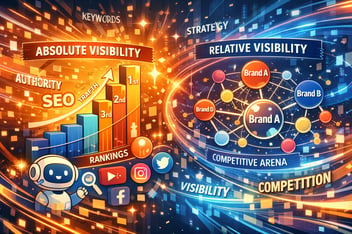
Competitive context matters because AI visibility is relative. Being present in AI-generated answers is a function of how your authority signals compare to the signals of the brands you're competing against. In a crowded, well-established category where multiple competitors have years of earned media history, breaking into AI recommendations requires overcoming a significant incumbency advantage. In a category where the competitive authority footprints are thinner, meaningful AI visibility can be built faster.
What We're Seeing in Practice
We've been running AI visibility programs with clients across B2B technology and industrial markets for the past two years. We track visibility across the major AI engines — ChatGPT, Google AI Overviews, Google AI Mode, Gemini, Claude, Copilot, and Perplexity — using structured query sets built around the prompts buyers in each client's market are most likely to run.
The results vary by client, but the pattern is consistent: clients who come in with an existing earned media foundation show measurable movement within the first few months of a focused program. Clients with thinner starting footprints show movement too, but it takes longer to happen.
One client we started working with earlier this year illustrates the faster end of what's possible. This company is a B2B technology hardware manufacturer whose primary category has been disrupted by two major platform discontinuations from larger companies. Buyers in their market have been actively searching for alternatives to brands that are going away. That discontinuation dynamic created a specific content opportunity: authoritative guides addressing those buyers by name, published on credible third-party platforms.
We established an AI visibility baseline in April. Two months later, after a focused earned media and content placement program, here's where things stand:
The company's overall AI visibility score — the percentage of tracked category queries across all engines where the brand appears in the answer — has gone from 47.5% in April to 52.9% in early June. Their top-3 rate, meaning how often they rank among the top three brands named in an AI-generated answer, has moved from 40.3% to 47.8%. Their detection rate has climbed from 54.2% to 59.5%. Average position has improved from 2.6 to 2.4, meaning the brand is being named earlier in the answer. And the percentage of mentions that are positively characterized — not just present, but favorable — has jumped from 72.7% to 83.2%.
At the engine level, the movement in ChatGPT has been the most pronounced: from 44.6% to 57.9%, a 13-point gain in under eight weeks. Google AI Overviews has moved from 48.6% to 54.8%.
The client now leads every tracked competitor on AI visibility and holds 33.6% of all AI citations in the category — meaning roughly one in three times any brand in this space gets cited by an AI engine, it's this client. That's more than double the nearest competitor.
The content placements are a direct contributor. Fifteen articles were placed on third-party platforms as part of the program. Ten of the 15 are already being cited by AI engines, all of them first appearing in late May and early June. In their first few days after placement, those articles were cited 60 times across platforms. On the prompts where those articles are cited, the client appears as a ranked brand 26 times, all of them in the top three, including nine number-one rankings.
The discontinuation-focused articles have been the most successful. An alternatives guide is being cited 15 times across all six engines in response to queries about what to use instead of a discontinued competitor product. A migration guide has become the cited source for queries about what happened to another discontinued competitor platform. In both cases, the client ranks second in the answer — directly behind the legacy brand named in the query. For a buyer who's actively trying to replace that legacy brand, that's the ideal position to be in.
Why Some Movement Happens Fast
The results above reflect what a well-executed program produces. A few factors explain why they came together the way they did.
First, the competitive environment created genuine buyer urgency. When buyers are actively searching for alternatives to discontinued products, content that directly answers those queries fills a real information gap. AI systems respond to that kind of alignment between query intent and content quality.
Second, the company already had a meaningful visibility foundation before the program started. The April baseline of 47.5% overall visibility isn't a thin footprint. The program accelerated and extended existing momentum rather than building from nothing.
Third, the content placements were on platforms that AI treats as authoritative sources, not self-published brand content. The placement strategy was specifically designed around AI citation patterns — identifying the outlets that the major engines cite most reliably in this category, then placing content there rather than on lower-authority platforms.
A Realistic General Framework
Based on what we've seen across clients, here's the timeline framework we use when we're setting expectations:
In the first weeks to months, the foundational work happens fast. You identify the specific prompts that matter in your category, establish a baseline, and fill in the most obvious gaps: thin review coverage, missing coverage in key trade publications, inconsistent positioning across sources. For clients with an existing earned media foundation, measurable visibility movement often follows within the first reporting cycle.
From months six to 12, the effects become more obvious. Each earned media placement builds on the authority established by earlier placements. AI systems start associating the brand with specific topics and attributes more consistently. Competitive gaps narrow and, in some cases, close entirely.
Beyond 12 months, the advantage shifts to defense and expansion. Brands with 12 or more months of sustained earned media work have an incumbency advantage that's genuinely difficult for competitors to overcome quickly if they aren't making the same or greater commitment to earned media. The question becomes how to extend visibility into adjacent topics and product categories rather than how to break into the initial recommendation set.
The two-month case study shared above is not an outlier. It's what focused execution produces for clients who come in with a reasonable foundation. For companies building from a thinner starting point, the same trajectory is achievable on a somewhat longer curve.
The Measurement Infrastructure Matters as Much as the Work
One reason companies underestimate their AI visibility progress — or overestimate it — is that they're not measuring the right things. Tracking visibility by AI engine, by query type, by competitive position, and by citation source gives you a picture that's actionable. Tracking it by what you intuitively think AI should be saying about you gives you noise.
We run structured audits at baseline and at regular intervals through the program because the visibility signals that matter are specific and quantifiable. Overall visibility score, top-3 rate, detection rate, average position, sentiment, and citation attribution by platform are all measurable. The movement in those metrics is what tells you whether the program is working and where to focus next.
The companies that see the clearest results are the ones that treat AI visibility as a measurable program discipline, not a vague aspiration. The measurement framework makes it possible to see progress that would otherwise be invisible, and to identify the specific investments that are producing the most movement.
What This Means for Planning
If you're building an AI visibility program into your marketing plan, the timeline question has a practical answer. With the right starting footprint and a focused earned media strategy, meaningful movement is visible within just a few months. Substantial competitive advantage is achievable within 12 months. A durable authority position takes longer, building with the investment over time.
The window matters. The brands investing in earned media and external validation now are accumulating the authority that AI will draw on to recommend them to buyers for years. The brands waiting to see how the AI visibility landscape evolves are not standing still — they're falling behind competitors who understood the opportunity earlier.
The questions worth asking now are specific ones: What does your current AI visibility baseline look like? Which AI engines are citing you, and on which prompts? Where do you stand relative to the competitors who are winning deals in your category? Those answers shape the timeline, the investment, and the strategy.

 12 min read